Installing Kernel Headers for Raspbian and understanding the internals of apt install

For generating kernel modules one needs kernel headers. Kernel version can be found by running

pi@raspberrypi:~ $ uname -r
4.14.79-v7

Headers will be present under /lib/modules/(kernel version)/build and by default raspberry pi doesn’t pack headers in the raspbian image.

I have always wondered how apt install (earlier popular as apt-get install) works, but never really went into the details of understanding it.
So while installing linux headers, I came across a weird problem. So this is what I did to install the headers.
Now run the below command to see if the headers are readily available through apt

pi@raspberrypi:~ $ sudo apt list linux-headers-*
Listing... Done
linux-headers-3.10-3-all/stable 3.10.11-1+rpi7 armhf
linux-headers-3.10-3-all-armhf/stable 3.10.11-1+rpi7 armhf
linux-headers-3.10-3-common/stable 3.10.11-1+rpi7 armhf
linux-headers-3.10-3-rpi/stable 3.10.11-1+rpi7 armhf
linux-headers-3.16.0-4-all/stable 3.16.7-ckt4-1+rpi1+b2 armhf
linux-headers-3.16.0-4-all-armhf/stable 3.16.7-ckt4-1+rpi1+b2 armhf
linux-headers-3.16.0-4-common/stable 3.16.7-ckt4-1+rpi1+b2 armhf
linux-headers-3.16.0-4-rpi/stable 3.16.7-ckt4-1+rpi1+b2 armhf
linux-headers-3.18.0-trunk-all/stable 3.18.5-1~exp1+rpi19+stretch armhf
linux-headers-3.18.0-trunk-all-armhf/stable 3.18.5-1~exp1+rpi19+stretch armhf
linux-headers-3.18.0-trunk-common/stable 3.18.5-1~exp1+rpi19+stretch armhf
linux-headers-3.18.0-trunk-rpi/stable 3.18.5-1~exp1+rpi19+stretch armhf
linux-headers-3.18.0-trunk-rpi2/stable 3.18.5-1~exp1+rpi19+stretch armhf
linux-headers-3.6-trunk-all/stable 3.6.9-1~experimental.1+rpi7 armhf
linux-headers-3.6-trunk-all-armhf/stable 3.6.9-1~experimental.1+rpi7 armhf
linux-headers-3.6-trunk-common/stable 3.6.9-1~experimental.1+rpi7 armhf
linux-headers-3.6-trunk-rpi/stable 3.6.9-1~experimental.1+rpi7 armhf
linux-headers-4.4.0-1-all/stable 4.4.6-1+rpi14 armhf
linux-headers-4.4.0-1-all-armhf/stable 4.4.6-1+rpi14 armhf
linux-headers-4.4.0-1-common/stable 4.4.6-1+rpi14 armhf
linux-headers-4.4.0-1-rpi/stable 4.4.6-1+rpi14 armhf
linux-headers-4.4.0-1-rpi2/stable 4.4.6-1+rpi14 armhf
linux-headers-4.9.0-6-all/stable,now 4.9.82-1+deb9u3+rpi1 armhf [installed]
linux-headers-4.9.0-6-all-armhf/stable,now 4.9.82-1+deb9u3+rpi1 armhf [installed,automatic]
linux-headers-4.9.0-6-common/stable,now 4.9.82-1+deb9u3+rpi1 all [installed,automatic]
linux-headers-4.9.0-6-common-rt/stable 4.9.82-1+deb9u3+rpi1 all
linux-headers-4.9.0-6-rpi/stable,now 4.9.82-1+deb9u3+rpi1 armhf [installed,automatic]
linux-headers-4.9.0-6-rpi2/stable,now 4.9.82-1+deb9u3+rpi1 armhf [installed,automatic]
linux-headers-rpi/stable 4.9+80+deb9u4+rpi1 armhf
linux-headers-rpi-rpfv/stable 4.9+80+deb9u4+rpi1 armhf
linux-headers-rpi2/stable 4.9+80+deb9u4+rpi1 armhf
linux-headers-rpi2-rpfv/stable 4.9+80+deb9u4+rpi1 armhf

So as you can see there is no package available for headers that are specific for my kernel release version.
Next option you can try is installing raspberrypi-kernel-headers

pi@raspberrypi:~ $ sudo apt install raspberrypi-kernel-headers
Reading package lists... Done
Building dependency tree
Reading state information... Done
The following NEW packages will be installed:
raspberrypi-kernel-headers
0 upgraded, 1 newly installed, 0 to remove and 176 not upgraded.
Need to get 16.1 MB of archives.
After this operation, 105 MB of additional disk space will be used.
Get:1 http://archive.raspberrypi.org/debian stretch/main armhf raspberrypi-kernel-headers armhf 1.20190401-1 [16.1 MB]
Fetched 16.1 MB in 8s (1,935 kB/s)
Selecting previously unselected package raspberrypi-kernel-headers.
(Reading database ... 161313 files and directories currently installed.)
Preparing to unpack .../raspberrypi-kernel-headers_1.20190401-1_armhf.deb ...
Unpacking raspberrypi-kernel-headers (1.20190401-1) ...
Setting up raspberrypi-kernel-headers (1.20190401-1) ...

This installs headers in /lib/modules/4.14.98/ and /lib/modules/4.14.98-v7+/
But my kernel version and the one installed just now are different. In all probability this version mismatch should not cause much of an issue. so go ahead and softlink the build folders as below

pi@raspberrypi:/lib/modules $ sudo ln -s /lib/modules/4.14.98-v7+/build/ /lib/modules/4.14.79-v7+/build

After this I tried building my helloworld kernel module program and it worked.

Now I was curious as to how apt install works, because I wanted to see if there is way to install 4.14.79 headers itself with some hacks
So I paid a visit to the http://archive.raspberrypi.org/debian presented above while installing headers. http://archive.raspberrypi.org/debian/dists/stretch/main/binary-armhf/Packages contains all the supported packages list for raspbian. How did I figure out the path you say. These are the keywords in the Get request stretch/main armhf. So that’s self explanatory.

Next search for raspberrypi-kernel-headers and you will see the below information about this package

Package: raspberrypi-kernel-headers
Source: raspberrypi-firmware
Version: 1.20190401-1
Architecture: armhf
Maintainer: Serge Schneider <[email protected]>
Installed-Size: 102107
Provides: linux-headers
Homepage: https://github.com/raspberrypi/firmware
Priority: extra
Section: kernel
Filename: pool/main/r/raspberrypi-firmware/raspberrypi-kernel-headers_1.20190401-1_armhf.deb
Size: 16145050
SHA256: df5a2806357cabf72ba63883123031392edf808c70496e242289161b05e60e9f
SHA1: af3a7ab6f6cfa568af168086620326b3c4fde6e3
MD5sum: 9a9864de27ca7114523f691e19da45c3
Description: Header files for the Raspberry Pi Linux kernel
This package provides the architecture-specific kernel header files for
the Raspberry Pi Linux kernel, generally used for building out-of-tree
kernel modules.

So the deb file pertaining to this package is present at pool/main/r/raspberrypi-firmware/raspberrypi-kernel-headers_1.20190401-1_armhf.deb under http://archive.raspberrypi.org/debian So that’s how the packages get resolved when you run apt install

still curious? Download this deb file onto your system


pi@raspberrypi:~/deb $ wget http://archive.raspberrypi.org/debian/pool/main/r/raspberrypi-firmware/raspberrypi-kernel-headers_1.20190401-1_armhf.deb

This file is just an archive so extract its contents with

pi@raspberrypi:~/deb $ ar xv raspberrypi-kernel-headers_1.20190401-1_armhf.deb
x - debian-binary
x - control.tar.gz
x - data.tar.xz

So this archive has the above 3 files. Of these debian-binary contains the version of the deb file and the control.tar.gz contains the maintainer and other relevant information. File that should interest you is data.tar.xz Extract this and you will find all the files that will get installed when this deb package is installed. This contains the headers that will be installed under /lib/modules/ and /usr/share/


Building Boot only Linux for RPi3 using Yocto

There are lot of articles on the web explaining how to get started with Yocto. I would like to talk about the same with little more details by building rootfs for raspberry pi 3. I would try to detail on what goes where, when you run a bitbake command as much as possible.

Assuming that you are running a sound Linux OS with python(preferably 2.7) and git installed, you can bake your own copy of Linux for Raspberry by following below steps

Clone yocto


git clone -b sumo git://git.yoctoproject.org/poky.git

Go ahead and change directory to poky. This folder houses the bitbake folder which has all the binary files that get executed when you run a bitbake command. There are lot of meta* folders which contain some standard configuration files and python files that worl on them. Among other things there is folder containing all the necessary scripts.

All the vendors who support building rootfs for their boards provide their own specific meta* folders like meta-intel, meta-ti etc. We need to get the one meant for RPi.
Clone meta-raspberrypi into the poky folder

git clone -b sumo git://git.yoctoproject.org/meta-raspberrypi

setup the environment for building

source oe-init-build-env <folder name>

This generates a build folder with <folder name>, if you do not already have one. If folder name is not supplied a directory with name build is generated.

build directory contains a conf folder which contains bblayers.conf. Yocto builds rootfs in a layered fashion and we can add the layers necessary. In our case, we will add meta-raspberrypi to the bblayers.conf file.


</pre>
# POKY_BBLAYERS_CONF_VERSION is increased each time build/conf/bblayers.conf
# changes incompatibly
POKY_BBLAYERS_CONF_VERSION = "2"

BBPATH = "${TOPDIR}"
BBFILES ?= ""

BBLAYERS ?= " \
/home/rohit/workplace/poky/meta \
/home/rohit/workplace/poky/meta-poky \
/home/rohit/workplace/poky/meta-yocto-bsp \
/home/rohit/workplace/poky/meta-raspberrypi \
"

Now open the conf/local.conf where you can change the Machine type, Packaging system and other settings. For simplicity sake, keep the default parameters and just change the MACHINE parameter. What should be the MACHINE value? Run ls in meta-raspberrypi/conf/machine/ folder to find the possible RPi machine configurations.

MACHINE ??= "raspberrypi3"

You might be already aware that RPi has it’s boot firmware stored in the GPU. Hence we need to reserve some memory in the GPU for that.

GPU_MEM = "16"

Now you are ready to generate image for your RPi 3.

bitbake rpi-basic-image

Yocto uses recipe files which contain the sequential steps for building the image. Yocto as it is provides most of the base class functionalities which can be inherited by other vendors, in our case RPi. rpi-basic-image.bb file corresponding to the image we are building is housed at meta-raspberrypi/recipes-core/images/
This file further includes core-image-minimal.bb. From here on it is just running find in the different folders of poky repository. core-image-minimal inherits core-image.
core-image.bbclass(meta/classes) in turn inherits image.bbclass(again in meta/classes). This file finally sheds some light onto how rootfs is going to be built and what it’s features and dependencies are. This is the starting point for the various tasks such as do_fetch, do_configure, do_compile, do_install etc. Unfortunately, Python is not my realm and hence I am compelled to stop this post here. I will cover the details in later posts.

Happy finding


In the company of men

This was in the offing for quite sometime.

I have for long been in the company of men who sacrificed their careers just to serve the society. I have seen people totally jeopardize their careers in order to work for the
philosophies that they believe in. You spend enough time with such people and you become one of them. These are the people who inspire me to work like them selflessly. I am part of an organization which I believe is in the business of Man-Making or as we call it Vyaktitva Nirman in Sanskrit. It pains my heart watching the kind of divisions that we have in our society today(I am talking about the recent development and not the age old issues.) Such events only serve as catalysts and motivate me to sweat and strive a little more.

I have also been in the company of men who excelled very high in their professional careers. I have quite a lot of friends who take hefty money back home as remuneration. On seeing the kind of impact that the technology has in today’s world and kind of people I had a pleasure of working and studying with, I feel I ought to do more and follow their path in creating a niche for myself. Countless times did I start studying an open source project, so that I can contribute to it a little, adding some brownie points to my profile in the process. So many times did I start competitive programming just to stop and wonder what to do next as I reach the halfway mark. I had started this blog to write technical content, but this blog is serving literally as a place where I rant about almost anything except technical.

Such has been dilemma that I often feel, I am not moving in either direction and have been circling round and round the same place I found myself almost six years ago.

Trekking in Kinnaur Valley – Rupin Pass

On the penultimate day of trek after having successfully led our team to the summit of the Rupin Pass, our trek leader Dushyant and the whole team sat down to talk a bit about the highlights of the last 8 days of adventure. While everyone was high on praising our guides and rightly so, some observations made by my fellow trek mates struck a chord in me. One such observation was that, for the last few days we were experiencing something that the money can’t buy. Although, we did pay money for the services of IndiaHikes, it was our sweat and blood that got us to the peak. Dushyant sir also added that, no matter how hard one tries, he/she can’t convey the involvement or the closeness that one had during these days with their surroundings.

Having said that, I will try my best to share the highlights and lowlights of my Rupin Pass Trek.

Coming up – More Photos of the team

Planning :

I was planning on joining a friend’s Spiti Valley bike trip since August 2016, but due to my limited driving experience on the mountainous roads and some health complications, I was more or less sure that I won’t be able to be part of it. This feeling had me looking for some other adventure activity and luckily Kishan, Anurag and Charan were also planning on some similar activity. We sat together and narrowed down the choices to RoopKund and Rupin Pass trek. Ever since the VOF trek, I was yearning for something difficult and few Google searches later it was apparent that Rupin Pass is considered difficult as compared to RoopKund(I know I am comparing Apples and Oranges, forgive me). Another hour of convincing and we were ready to sign up for Rupin Pass trek. After a lot of delays we settled for 28th May batch.

27th May – Bangalore – Delhi – Dehradun
Dehradun ticket was turning out to be expensive so we had booked a train from Delhi to Dehradun. We were already exhausted by the time we boarded the train thanks to the infamous scorching sun of Delhi and our little misadventure of going to Connaught Place by walk. We reached Dehradun at 10 PM and after a heavy dinner we slipped off to sleep. One take away from day 0 : we no longer have the curiosity or the patience it takes to travel by train.

28th May – Dehradun – Kempty Falls – Purola – Dhaula
We reached the Dehradun Railways station at 6.30. There wasn’t much interaction with others since the 5 of us(I, Anurag, Charan, Kishan and Guru) boarded a Ertiga and rest boarded TT. We left at around 7.30 and stopped for breakfast at Kempty Falls. The sumptuous breakfast troubled Charan and our speed was hampered a little. Nevertheless we reached Dhaula by 5 PM. We only stopped at Purola for lunch(Pahadi Rice, Rajma and Mandwa roti). Travel through the thick pine forest was only made better by the heavy hail rain. Rest of the trek mates joined us soon.

One of the best part of Rupin Pass trek is that all the camps are situated right next to the Rupin River. Omansh (Asst Trek leader) welcomed us. After a stroll on the river bank we were briefed by Dushyant Sir and were introduced to the rest of the team. We quickly fell asleep after the dinner.

29th May – Dhaula – Sewa
Timing for the day was 6 (tea) – 7 (breakfast) – 8(departure).
It suffices to say that, I have never before in my life enjoyed the morning tea as much. My stomach was feeling a little uneasy and so I decided to offload my backpack. Eco bags were something new and everyone was eager to collect as much waste as possible. This enthusiasm died down slowly and was also not necessary, since Dhaula-Sewa stretch happens to be the most accessible of all for tourists and hence the most dirtiest. I had plenty of Idlis and corn flakes for breakfast, so I comfirtably reached Sewa with plenty of energy. Kofta Kadi Chawal was served for lunch and that’s how we all got introduced to the famous cooks of IndiaHikes.

Sewa is a quaint little village where our stay was arranged in a Home Stay. After having sufficiently rested, everyone played cricket and some games which helped us in getting to know each other, everyone’s names to start with. We also visited a temple built in the Kinnauri style. These temples are special in a way, as they don’t have an installed idol of God in it and are opened only on special occasions. After dinner everyone was narrating the Supernatural experiences that they had had and Omansh appeared to be particularly scared of some local ghost story he had heard from Devendra or Praveen. Devendra and Praveen were our trek guides who hail from Sankri, a small village which often supplies a lot of local trek guides and cooks for all the trekking communities in the vicinity.

edf
Temple at Sewa

30th May – Sewa – Batwa – Jiskun
Availability of normal water while pooping is rare luxury and it’s availabilty in Sewa had got my stomach alive and kicking. Timing for today was 5-6-7. We crossed over into Himachal in between and difference was fairly visible. Himachal part of trek appeared to be more cleaner and availabilty of a motorable road and electricity was a sweet surprise. In the Batwa village Nasha Mukti(De addiction) drive was being held and as part of it, the local school students and teachers were cleaning out the weeds that had grown on the road side. The ample availabilty of weed here often drives the local youth towards drugs and a step towards curbing that is a welcome sign.

sdr
Wooden bridge that takes you take Himachal
sdr
Nasha Mukti Drive at Batwa

A walk for another half an hour takes you to the Jiskun village. Jiskun is probably the biggest village in the surroundings and the home stay that was arranged for us was one of the best home stays I have ever stayed in. We were served Dal Makhni Chawal for lunch and Lingda sabji(a local fern that grows in the mountains) and Phulka for dinner. Dushyant took the trouble of explaining HAPE and HACE in great detail and how to operate the oxygen cylinder. We also had discussion on Dushyant’s experience of working in Kashmir in particular and in general his experience of working in the mountains.

sdr
Jiskun Homestay

31st May – Jiskun – Jhakha – Udaknal
Our day started with tasty Sidku(Pahadi Modak ?) and Cheela(Sort of Dosa) breakfast. We knew that we had to walk 12 kms to reach Udaknal. Exhaustion of the steep ascent to Jhakha vanished in thin air as soon as we reached a local Lassi joint. The proprietor’s daughter was very graceful and good-looking and everyone in our team appeared to be smitten by her beauty. Devendra and Praveen bhai had surely refilled the entire team with ample energy for the rest of the day and she remained the talking point for the entire duration of the trek.

sdr
Rhododendrons, Pines and Snow capped mountains

Jhakha happens to be the last village on this trail. We had our lunch near a roaring waterfall some 2 kms from Jhakha. After about 150 meters we get to the last Dhabha en route. It was surprising to find the valley still laden with the beautiful Rhododendrons of different colours. I felt this trail was the best trail of trek as the mighty pines and Rhododendron trees made way for the shorter pine trees and eventually to Rhododendron shrubs. As we gradually progressed towards Udaknal we could see meadows that lay ahead. The snow capped mountains were no longer playing hide and seek and were always visible from here onwards. We reached Udaknal by 3.30 PM. We feasted on the tasty Baingan ka Bharta and tasty dal at night.

1st June Udaknal – Lower Waterfall(Danderas Thatch)
I thought this was the most difficult day as far as hiking is concerned since the trail was steep. The Cheela we had for breakfast, however provided the necessary impetus and we were at the camp well before lunch time. As we approached the camp site we could see the valley opening up like an amphitheatre which is starkly contrast from the Udaknal camp which is situated in narrow valley. We met the previous batch who were acclimatising at this camp and played some team games. Our team with almost every member aged less than 30 trounced the other team hand over fist. Trek Leader of the other team, Jude was very experienced at star gazing, from whom we learnt a lot about identifying constellations and stuff.

burst
Amphitheatre – Lower Waterfall camp

Camp here provides the best view of the waterfalls formed by the Rupin River, which at first looks easy to cross. But I couldn’t find a single point to cross the river and greet the cattle grazing greedily on the other side of the river. In the evening Praveen led us to the closest waterfall point. Even though we had crossed the Snow bridges 2-3 times before, it was here at the waterfall point that all of us got to experience the snow thoroughly. Standing next the thundering waterfall on the snow bridge watching the river fall into the abyss was an exhilarating experience.

2nd June Acclimatisation day
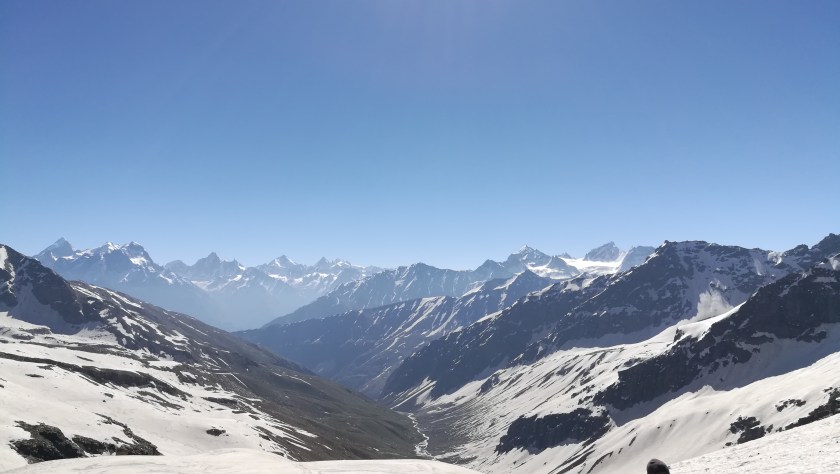
The acclimatisation day is a newly introduced concept at IndiaHikes and as part of it, trekkers are supposed to gain a height of 1000 ft approximately and return back to the camp. The only point which appeared to have such an elevation was a saddle point opposite to our camp. With an aim of keeping his flock together and instil a team spirit in us Dushyant decided to have a formation wherein the slowest member would leading the pack. As a result the climb was slow and less tiring and we reached the saddle well past 11.30AM. The people at the back found it to be frustrating at times, but later made their peace with it. The snow capped mountains and the valleys underneath were provided a panoramic view.

dav
View from the Saddle point

To save time and reduce the distance to be covered, Dushyant decided to take the route the sheep and shepherds followed while descending. This route was very steep and walking through the Rhododendron shrubs and loose rocks was difficult for some trek-mates.

3rd June Lower Waterfall – Upper Waterfall
This is by far the most easiest day of trek wherein we had to walk less than 3 kms to reach the Upper waterfall camp. Even the slowest leisurely walk didn’t take us more than 3 hours. Upper waterfall camp also happens to be the best camp in the the Rupin Pass trek, where the same Rupin river which was thundering wildly in the valley down below, flows quietly in an innocent way. The only blot in the landscape is the presence of irritating buzzing flies.

We had an early lunch and left to have some fun with Sliding in the snow. Crossing the river for a good patch of snow itself was very difficult. After some initial sucess I found it very hard to reach the place from where everyone was sliding. I slipped and slid atleast 4 times before reaching the point. The only regret that I have from the entire trek is that I was not even able to attain the beginer level of 2 point climbing in the snow.(hiking the snow mountains without any instruments) We were thoroughly charged up after the slide and were not in a mood to walk another km just to cross the river and decided to run in the waist deep river water flowing from the glaciers not far away.

After photo session on the top of waterfall we called it a day.

sdr
View from the Upper Water fall. Yellow Green dots is the Lower waterfall campsite

4th June Upper Waterfall – Summit – Rhonti Gad
Timing for the day was 3.30 – 4 – 5. We were introduced to the 2 technical guides the previous day and they expected us to be prompt and we didn’t disappoint them. We started slowly since the initial hike was very steep with the earlier mentioned formation. After about a kilometres walk, terrain gradually became easy and made way for the snow as we reach Rhata Pheri. We had some time for clicking photos before embarking on the most awaited Rupin Gully Hike. Gully is extremely steep and might appear scary at times, but to my understanding a slip on the way will not harm one physically but might harm his/her morale. (Yes there are boulders and rocks underneath, but most of them were well covered with snow during our trek). The technical team had done an impeccable job at step cutting and the hike appeared to be a walk on the cake(pun intended). We were atop the summit at 8.30 AM.

dav
Rhata Pheri

View from atop the summit was scintillating and the technical guides introduced us to the various mountains that were visible.(I remember only Kinnaur Kailash).

dav
View from the Summit

The climb down from the summit was one of the most satisfying one as we got slide on the snow-laden slopes 3-4 times. As we descended down the mountains, with the reduction in the amount of snow the trek started to appear more and more mundane and boring. We reached the Ronti Gad camp at 2 PM with just one stop for lunch in between.

Ronti Gad is famous for it’s blasting wind and it was apparent as we were all chatting about our next adventure activities. I also leant how to play poker the same day, but never actually got an opportunity to play. In the evening we all sat down to reminisce the sweet memories of the trek. Naina Bhai’s(Head of the Ronti Gad camp) cake was icing on the cake.(Considering the fact that it was prepared with the ingrediants that are easily available at 13100 ft)

5th June Ronti Gad – Sangla – Shimla – Chandigarh
It suffices to say that the last day was pretty boaring except for the fact that we had to hike up kilometer distance in Sangla city with an extremely hot sun on top.(Most of us found this to be most difficult stretch of all)

We left Sangla with a gloomy face after bidding adieu to everyone, but the serpentine roads en route to Shimla got the energy back. Yashpal and Navneet got down at Shimla and we transferred ourselves into an Innova after a light dinner. We reached Chandigarh at 3AM.

Epilogue :

This trek has opened up new dimensions of thinking in me and was a welcome change to the monotonous life that I lead at Bangalore. I met people from various walks of life with varied professions and interests. All my trek mates and guides(and the Himalayas of course) have given me the much needed to push to get out  of the lethargic attitude and at least think of trying something different with life. And I hope this experience teaches me how to say ‘Jagah Kaha Hai’ to all my life’s problems.

Visit to Sirsi and it’s surroundings

I was in Sirsi during the first weekend of March to attend a colleague’s wedding.That gave me an opportunity to explore some of the tourist attractions nearby. Although, I belong to the same district as Sirsi, I had never really had the occasion or the company to visit these places.
We(Praveen, Vinayaka, Dhanush and I) started on Saturday morning from Bangalore at around 7 AM to reach Sirsi at around 1 AM. Vinayaka, a native of village near Sirsi had an itinerary ready for us. Sirsi town is part of the western ghats and lies comfortably away from the sea, thus offering a moderate temperature.
After lunch, we ventured into Sondha 25 kms away from Sirsi. Sonda or Sodhe was once ruled by the Chiefs of Vijayanagara Empire. Their orderly rule is still cherished here and remnants of it can still be seen. Sodhe is the headquarters of Sodhe matha one of the Ashtamathas established by Sri Madhvacharya. This matha is also known as Vadiraja Matha named after Sri Vadirajatirtha. Our team, not so religious by nature, decided to skip the Matha and visit the Tapovana, place where Sri Vadiraja used to medidate. This place is deep inside the forest, on the banks of River Shalmala and we had to take the help of a local boy Shravana in finding it. It takes 4kms of drive on a mud road and then a walk of about half a km in the jungle to reach the river bank. River had almost dried up and the walk on River bed was made more arduous by scorching river stones. We saw the stone markings nearby indicating Sri Vadiraja’s meditation place. Soon after, we bid adieu to Tapovana and headed back to Sondha. There are other points of interests in Sondha like the Swarnavalli Matha, Swadi Jain matha. There was plenty of adventure still left in us and that drove us to Shivaganga falls.

IMG_8940

(Markings at Tapovana)

IMG_8971

(Shivaganga falls)

Shivaganga falls is another 30 kms of Sondha. After moving through a well laid road from Hulekal, Vanalli and Mensi village we reached viewpoint.Thick forests were like icing on the cake which made the drive a soothing experience. The small Sonda river falls into a deep valley covered with thick flora and presents a captivating view. There are steps to trek down to the valley which seemed like least used. After trekking down a little we decided to head back as the sun was starting to settle down.

From Shivaganga falls we drove to Sahasralinga, again on the banks of Shalmala river. The river valley is adorned with multiple Shiva lingas and Nandis. A small stroll on the river bank and few Kokum juice later we headed back to Sirsi.

Vinayaka had arranged for us a home stay in Sutlamane, near to Kageri, about 5 kms from Sirsi. After a hearty meal, we slipped into deep sleep.

Manju joined us next morning. Although we had planned to get up by 6 and get ready to go to Vinayaka’s place, we could hardly implement the plan, thanks to the exhaustion caused by the previous days walk and travel. Early morning dew and the chill was pleasant surprise. We were ready by 8.30 AM. After devouring the Idlis we tightened our seat belts for a visit to KodnaMane,(Vianyaka’s native place) a small hamlet close from Amminalli, on the Sirsi-Kumta road. After snacking and exchanging pleasentries with Vinayaka’s parents and relatives we headed to Unchalli Falls also known as Lucington falls. Unchalli falls is about 10 kms from KodnaMane. In fact, Kodnamane is a detour from Heggarani road, which takes you to Unchalli. So for those visiting directly to Unchalli can take the Heggarani road from Amminalli on the Sirsi-Kumta road.

We reached the falls start location by 10.30. Local authorities have developed the place to a good extent and after walking for half a km, we get nice view point. This is were the conventional tour ends and if you yearning for more thrill, you can trek down to the valley where the River Aghanashini plunges 114 mts to form a pictursque view. The trek is laden with rocks and tree trunks and is strenuous and steep all through out. Despite this, it was a delightful experience thanks to the forest cover. With the summer onset, all the smaller tributaries to the river except one on the trek route had dried up. It took us about 45 minutes to trek the approximately 2km stretch to reach the river bank. It takes another half a km of walk on the mighty rocks to reach the water fall location. We drank the sweet river water to the fullest to quench our thirst and then jumped into the river water after finding ourselves a nice little place with plenty of water to wet ourselves and just enough water not to drown ourselves. We started to trek up at around 1.30PM. I decided to go ahead as I always do since I believe walking slowly causes more exhaustion while trekking up. I reached the view point by 2 PM and was joined by others by 2.15 PM. I found the trek to be easy, but if you have got no trekking experience and are living a lazy life with no prior history of physical workouts then you might find it difficult as Dhanush did.

(Trek location)

All the calories burnt in the trek got refilled at Vinayaka’s place with a simple and splendid meal. We then got talking with our hosts about all kinds of topics ranging from politics to lifestyle. Later we went to get some farm action in Vinayaka’s family’s Arecanut farm. The vegetation here is different from that of the other parts of Kanataka and we got ourselves a little acquainted with it in this farm. As the Sun was getting ready to set we a headed to a sunset point nearby, named Beemana Eri Gudda. We reached the point at least half an hour before the sunset, all credits to Vinayaka’s driving who thought we might miss the sunset. I am not a ‘Sunset person’ and can’t recall watching a sunset in the near past, making it a different experience.

IMG-20170306-WA0003

(Beemana Eri Gudda – Aghanashini can be seen in the background)

Thoroughly exhausted, we still found time to play Ludo before falling to sleep. We picked up Ganesh the next morning and after making sure that our stomachs are crammed with Neeru Dose, we went for Sirsi Marikamba’s Darshan. From there, we went to Kadamba store in the APMC ward. Kadamba is a co-operative society which markets the forest products and local food items from the nearby villages. Since most of the products sold here are difficult to find in Bangalore, we found ourselves unable to decide as to what to buy and what not to buy.

Thanks to all the teetering and the crowd at the store, we reached the marriage venue a little late. After a small photo op and light lunch we began our return journey at 2PM.

IMG-20170306-WA0008

(Guy who facilitated our Sirsi visit by getting married :D)

To summarize, March is not the best time to visit Sirsi, but it’s not bad either. If you are planning a holiday near Sirsi, it better be in October, November when there is lot of greenery around.


A short visit to Tilmati Beach

I have had my fare share of beaches while growing up and therefore I don’t get too excited whenever beach visit is in the offing. But Tilmati was different. Tilmati in Konkani (or Marathi for that matter) means Sesame soil and that got me curious. A beach with black sand.

The beach is situated in Goa close to Karnataka border. To get here, one has to take a left on the NH 66 towards Goa, some 3 kms away from the Ramanath cross of Majali . After driving for another kilometer you would reach a point from where no 4 wheelers can go.(This is the route Google suggested, there is another route through Gabitwada, which would save you from a 200mt walk).

After this you would reach a messy beach from where you need to trek on a small hillock to get to the Tilmati beach. This must be around 700- 800mts of trek. While you are trekking you cross into Goa. We also saw a spot where the water level rises very high once the tides hit and goes down drastically once the tides die down. This beach is in the middle of nowhere and hence somewhat far from humanity. That makes the walk calm and serene despite the sea roaring just some meters away.

Because of the small hills en route one can’t see the beach from far. Only after crossing the last trough a black stretch of about 150-200 meters becomes visible. The beach is made of a special kind of stone(which look kind of painted) which is the reason for the black sand. Sand particles being larger in size do not mix up with water much which makes the water very clean and tidy. We didn’t trouble ourselves much with an adventure because the water was found to be running deep after taking 10-12 steps.

All in all this is very good place who want to spend some time with their near and dear ones in a quiet beach away from all the outside world mess. A world of caution is in order, the trek does get a little steep at one or two places and is not advised for the elderly. If you are seeking a miniature trek and happen to be near Karwar, then please do pay a visit to this place.

Signing off with some photos.

Pic Courtesy : My brother, Rahul.

In the waiting line

Back in 2009, while I was doing my undergraduate studies, a friend suggested me to watch a movie named Girl, Interrupted. I had just started watching Hollywood movies with a penchant for action and thrillers. This movie was a different genre altogether. I still watched the movie and liked it to a good extent. I drew one conclusion from the movie. It’s very important to express your feelings.

The movie is based on the experiences of Susanna Kaysen(played by Winona ryder <3), an American author in a psychiatric hospital. I vaguely remember the plot now, but here is the essence of it. The Girl is introverted and often keeps to herself. There is lot cooking inside her head but it’s never let out. This leads to behavioural changes which kind of rattles her family members and as a result she is sent to a psychiatric hospital. She is diagnosed with Borderline personality disorder. While there are patients with vaying degree of insanity there, she makes few friends among them. The death of one of her friend Lysa makes an impact on her and she starts writing to express her feeling and thus venting her anger and anguish. The essence of the film being, the more you supress your feelings, the more paranoid you become.

In every stage of our lives, we find someone to talk to. While we are kids, we share everything with our mother or father. As we grow old, we confide in our friends and siblings. This role is then taken up by ones significant other. If any of these links are missing, then we start keeping to ourselves. Introverts especially find it difficult to begin a relationship. It’s not that, they do not have the knowledge that an extrovet has. It’s just that, the topics that extroverts speak, often seem mundane and pointless to the introverts. Smalltalk never interests an introvert.

But here comes the caveat. In todays world love is often first expressed in words, than in deeds. An introvert is set to lose this game if the girl/boy he/she’s hitting on is not so close. Whatever amount of courage you gather from various sources, goes kaput when the moment arrives. I once read a suggestion on Quora from a fellow Quoran, which read “Fuck the outcome !!”. But Introvert being an introvert often dwells in low self esteem until someone comes to break you free from that confinement.

Are you waiting for that someone ?

Bonus : One of my favorite songs : In the waiting line


Valley of Flowers and Hemkund Sahib Trek

“Fuck, Fuck, Fuck”, I blurted after a quick dip in the lake.

Suhas was profusely laughing while taking the snaps. I looked around and people near me were smiling. Expressions on their faces were saying, “Been there, Done that”. I was relieved that no Sikhs were around to hear me. I felt bad for having uttered those words in one of the most sacred places of pilgrimage on earth for the Sikhs. I took another quick dip in the freezing water and came out shivering. But it was worth all the effort.
Short VersionGo to 10th, 11th, 12th and 13th Aug during which we actually trek in the valley.
Seeds:
I am not sure as to whose plan it was originally to trek in the Garhwal Himalayas. After making sure that there is no place left in our stomachs for more pizzas, we went back to Vijay’s place. Since Vijay was heading to the US for further studies, there was nothing much left to inquire about his future plans. I casually asked Suhas, as to what he was planning next. As usual he had a plan ready. Suhas told me that he along with 9 other people was going for the Valley of Flowers trek and I could join if I am interested. After thinking for about a minute I said I would join them. Suhas took some time to confirm if I can hop in, and after his confirmation, finally, with some 20 days left I booked my tickets.
7th Aug(Delhi):
Scheduled departure of my flight to Delhi was 8AM. I was ready to board the bus at 5AM. Pace of the bus worried me a little which made me get down in middle and book Uber. I reached the airport at around 6.30 AM. After having stuffed a subway burger, I was ready and looking forward to the journey that was about to begin.
Train to Haridwar from New Delhi station was scheduled to leave at 11.50 PM. So I had more than 12 hours to roam around in Delhi. We were all meeting at the New Delhi station.
Team:
Suhas – Friend from Engineering days
Akash – Suhas’s cousin
Rishita – Akash’s wife
Supreetha – Suhas’s cousin
Chetan – Akash’s friend from his PU days
Naren – Akash, Chetan’s friend from Engineering days
Navya – Naren’s wife and friend of Akash and Chetan
Nisarga aka Akka – friend of Naren and Navya
Kiran – Suhas’s colleauge
Vishwa – Kiran’s Engineering friend
dsc_8392
(L-R : Chetan, Akash, Rishita, Supreetha, Suhas, Navya, Naren, Vishwa, Kiran, Nisarga, Myself)
I didn’t know anyone other than Suhas in the group. Akash and Supreetha’s names were constantly on Suhas’s lips, so I knew that they were travel buffs as well. Kiran and Vishwa were already in Delhi when I reached. Nisarga was supposed to catch us in Haridwar. I didn’t know that Kiran and Vishwa were also new to Delhi, I thought they must be having some friends to show them around.
I had checked with some of my colleagues about which places to visit in Delhi. I thought Akshardham temple would be good which I came to regret later. Yes the temple has some good architecture but I was expecting a serene place and it turned out to be a Religious Shopping complex. I learnt that the BAPS trust which handles the temple does some real good work in the sphere of spirituality and I plan to visit their smaller temples to actually get to know them better. Scorching Sun of Delhi made it worse for me and I blame the sun for ruining my Akshardham temple visit.
When I left Akshardham it was already 4 PM. I then decided to visit the famed Chandni Chowk and have some Delhi street food. Poverty and dirty streets of old Delhi came as a shock to me, at the same time I also found myself appreciating the effort put by Delhi metro in building a metro station there. (Considering the pace of Bengaluru metro)
Within 10 minutes of walk from station I found a temple, a Gurudwara, a mosque, a church and a Jain temple in the vicinity(Speak of religious tolerance).
I aimlessly strolled in the streets for some time. Some of the famous eateries I had noted down were very close. First I savoured Jalebis fried in Ghee and Rabdi at the Old famous Jalebiwala. I had to struggle a lot to find the Parethewali Gali as Google was completely helpless in finding the place. While looking for theParethewali Gali, I found a Red Wall, which turned out to be the Red Fort. By the time I reached the rear side of the Red fort, I was too tired of walking and decided to head back to the alleys of Chandni Chowk. After walking for some 20 minutes I was finally able to locate the Babu ram Devi Dayal Parathewale. But as soon as I saw the deep fried Parathas I decided not to eat them. I then headed to the Nataraj Dahi Ballewala to savour some amazing Dahi Balles.
After having satisfied the hunger, I decided to head back to New Delhi station as I was feeling feverish. Near the station some people were watching the Olympics Archery Quarterfinals. I joined them and watched the match for a while. I had a feeling that India might lose, so I headed back to the station. By 7 PM I was at the New Delhi station. I had to wait for another 2 hours before Kiran and Vishwa joined me at the station. By 11 PM everyone was at the station. After boarding the train, had a brief chat with everyone. Then I and Suhas headed to our coaches. We tried doing some seating adjustments which were not fruitful. We chatted for a while and went to sleep.
8th Aug(Haridwar):
We reached Haridwar around 4.30 AM and went straightaway to our place of stay, Tayal Dharmashala. This booking was done by Bluepoppy holidays, our tour planner. We covered our sleep quota a little and had breakfast around 9AM. We didn’t have any specific plans for Haridwar, so decided to take a dip in the holy Ganga and set off to Har ki Pauri(Lord Shiva’s steps), a famous Ghat in Haridwar. We were all exhausted from the walk we took to Har ki Pauri. A dip in the Ganga brought us alive. Looks like Nisarga had done some research about Haridwar and we got to know that there is famous place nearby which serves delicious Puris. We had to walk for about half an hour before we could find the place. A Sweet and spicy curry made of pumpkin was a treat to the taste buds. We roamed a bit around Har ki Pauri and then retired back to Tayal. I saw a big queue for entering the Mansa Devi temple nearby, but nobody in our team was enthusiastic about visiting a temple, so I let it go.
Chetan had a big task waiting for him in Tayal. He and Akash had arranged a bit of Hash(Hashish). Chetan was now carrying the hopes of 10 people to prepare a good joint. He was the joint boy during the entire duration of the trip and he did an excellent job. Effect the of Hashish wasn’t lasting long, so we cursed the Babas we got it from and left to have lunch. A small hotel next to the Tayal Dharmashala offered great food at an economical price.
After taking some rest, we went back to Har Ki Pauri, this time on a rikshaw, to watch the Ganga arati. The Ganga Aarati was a treat to our eyes, as non of us had seen such a sight ever before. Navya, Rishita and Supreetha offered Diyas to Maa Ganga. We strolled a little near the Har ki Pauri and went back to Tayal.
9th Aug(Haridwar – Joshimath):
As per the plan we were supposed to leave for Joshimath at 6.30 AM. Roads in Garhwal are prone to landslides and it is always advised to leave early. Although, the distance is less than 300 Kms, it took us 11 hours to reach the destination. We left by 7:15 AM. Our driver, Rajeev Tyagi, was a man good at making lofty claims. It’s said that, If you want to sell a lie, add a little truth to it. He did exactly that, during the entire duration of our journey. Nevertheless, he was excellent behind the wheels and we truly came to appreciate his driving skills while going to Badrinath as it was the most treacherous route in our trip.
We stopped for breakfast at Byasi and for lunch at Srinagar. On our way we crossed some of the famous Prayags in the region, DevPrayag, RudraPrayag, KarnaPrayag and NandPrayag in that order. Rajeev initially tried to make us understand which river meets which tributery where, but gave up later after knowing that it was too much for us to take at one go. We were elated at seeing the small streams and waterfalls, unaware of the far greater ecstacy that we were goingto witness in the next 4-5 days. The tranquilizing effect of travelling in the evergreen Ghats watching Ganga and its tributeries flowing effortlessly, is something that cannot be explained in mere words.
img_20160809_105514
(DevPrayag)
Our speed was hampered a little at 2-3 places because of the landslides. These roads are maintained by the Border Road Organization(BRO) and as a result they were cleared steadfastly. We didn’t have to wait at any place for more than 15-20 minutes.
14222242_10209096707127858_4632040693899203190_n
(Waiting for the landslide to clear)
10th Aug(Joshimath – Ghangaria):
Our stay at Joshimath was arranged at Hotel Dronagiri. Our guide Ashish Panwar, had briefed us on the trek that we were going to carry out a day before, and we ready to roll by 7:15 AM. But due to delay by another team from Bluepoppy, we had to leave at 8:15 AM. After a delicious breakfast at Govindghat, which is another 20kms from Joshimath, we took a Jeep to go to Pulna village from where the trekking actually starts. This distance is around 3 kms. But because of the landslides, we could only cover one km on the vehicle. So we began trekking from there itself.
Initial 3 kms were somewhat steep and all of us were walking slowly to keep company. We had an early lunch near Bhyundar, 5 Kms from Pulna. During the heavy snowfalls of winter Govinddham(Ghangaria) is vacated and people settle in Bhyundar. After lunch, I could not keep up with the others’ slow pace, and left with Suhas. We reached Ghangaria by 5.30 PM. The last strech of 3 Kms was also steep. We also met a professor from SJCE, Mysore, Mr. SampathKumar. Supreetha was his student and she identified him pretty quickly. We had a nice little chat with him on his itinerary and about other happenings. He had a group of 6 people of same age as his. Everyone except him had taken ponies to reach Ghangaria. We also got to know about pricing by other tour planners. The most popular and also one of cheapest tour planner was GMVN(Garhwal Mandal Vikas Nigam), run by the Uttarakhand govt. GMVN charges around 7000 Per person, for the entire trek.
Everyone was exhausted from the 13 KM trek. Our masseur, Anil helped us ease some pain. After the trek, my metabolism had probably bounced off the walls and I could eat almost anything and everything thrown at me. After dinner, we played rummy for a while, but later it started to annoy as 10 of us where playing and it used to take close to 3-4 minutes for one’s turn to return.
11th Aug(Ghangaria – VOF – Ghangharia):
We started around our usual time of 7.30 AM. We had spoken to some of trekkers who returned from VOF the previous day; Pushpawati river bed is 9 Kms in total from Ghangaria. The first 3.5 Kms were a little steep, after which the terrain became easier to walk. Walking another 3 kms from the river bed would take us to the closer view of nearby glacier.
_dsc1842
I had made up my mind to reach the river bed by 11 AM. Some were having hard time catching up, so I decided to part ways and walk faster. I reached the big rock(a milestone) by 9.30 AM, heavy rains welcoming me. I abstained from taking too many photos, for various reasons, one I am not a flower person, two I wanted to spend maximum time at the river bed and I wanted to find some secluded place and spend some time alone. After walking for some time, I couldn’t see a single human being for about half an hour. There were lot of streams on the way, some big, some small. Final two streams were somewhat difficult to cross and I could see some people stumbling to find balance. At one such streams, I didn’t have the courage to cross alone. (I didn’t want help per se, I just wanted somebody to notice, if I drown :D)
I reached the river bed by 11:45 to see only 9-10 people around. I had missed practicing Shambhavi Mahamantra in the morning, so I decided to practice it at the river bed. The ‘enlightened’ me then decided to have lunch. Stale and cold parathas were difficult to eat, but I stuffed them in my mouth anyway. I conversed with some of the trekkers there about other trekking routes and their itineraries. One person with whom I stroked a cord was a fellow named, Abhishek Verma, a student from Gorakhpur. He had a lot of information on trekking routes, two of which I found very intriguing: Swargarohini trek and Chandrashila trek.
We left the river bed early (12:45 PM) as the weather condition was getting worse and we feared some of streams on the way might get swollen. We were at the big rock by 2 PM, only to find our 3 guides waiting for me. We started walking steadfastly and found Kiran who was helping an old lady in descending. Kiran asked me to relieve him for a while and I then helped old lady. She was from Pune, both of us beingMarathi Manus, we bonded well. Once the steady decline was over, she decided to walk alone. I Walked a little more distance to find Suhas and Supreetha still enamored by the beauty of what seamed to them like amazon forest. We then walked slowly to reach the hotel by 5:30, after having some snacks and tasty Gulab Jamun in the Ghangaria village.
 _dsc1794
12th Aug(Ghangaria – Hemkund Sahib- Ghangaria):
A lot of people we met in the past 2-3 days were of the opinion that the trek to Hemkund Sahib was way more difficult than whatever treks we had done, in the past 2 days, some even said that, it is 10 times more challenging than the VOF trek. This made some of us uneasy; Naren decided to take pony to reach the Hemkund Sahib, as he was already suffering from shoe bites. Navya and Vishwa accompanied him. Rest of us decided to walk. We left a little early than our usual time, by 7 AM. I once again decided to leave others behind, as I couldn’t catch up with their slow pace. Solitude is something which I have always enjoyed and I never miss an opportunity to grab these small moments of loneliness. I did miss taking pictures with everyone though, at the same time I was also aware that, it was the price to pay for some loneliness. (Whoever is delighted in solitude is either a wild beast or a god – Aristotle)
I did try making smalltalk with some of the fellow trekkers, to get to know more about Hemkund Sahib. I met a Sardar from Lucknow, Sunny Paji, who acquinted me with the history of Hemkund Sahib and about Guru Gobind Singh Ji, to whom this Gurudwara is dedicated. It is believed that, Guru Gobind Singh ji in his previous life, medidated here, as a result of which he was born as the son of the Ninth Guru of Sikhs, Guru Teg Bahaddur. Guru Teg Bahaddur and Guru Govind Singh lead the Sikhs and Hindus during one of the worst periods of Indian History, i.e, during the Aurangajeb’s time. The atrocities that were committed on Sikhs and Hindus during his period can form the contents of a far bigger post or a far fatter book. I only learnt later that, the Gurudwara that I had seen in Chandni Chowk, Gurudwara Sis Ganj, is where Guru Teg Bahaddur was beheaded.
We (Sunny Paji and I) reached the starting of the steps at 9AM. We waited there for a while for Sunny’s uncle, who had been doing this Sangat for the past 15 years. There were 2 routes to reach the Gurudwara from here. One the steps, the other being the normal route made only recently. Sunny urged me to take the steps as it is a traditional and old route. We started again at 9:15 AM and it took us another 30 minutes to reach the Gurudwara.
_dsc2027
(With Sunny Paji and his uncle)
Sunny Paji advised me to take dip in the lake soon, since the body will be hot and sweating from the trek. I wanted photos of me taking a dip in the lake, so I decided to wait for Suhas who was right behind me when I had last checked. Suhas and Chetan arrived at 10 AM and I decided to take quick dips in the lake. Water was freezing cold and I could feel parts of my body going numb after one dip. I thought 2 dips are good enough for me, having seen Sunny, a devout Sardar taking one. Later after seeing Chetan, Kiran, Vishwa taking 3-4 dips made me feel, that I could have taken more dips. Akash was a league apart and he decided to jump in the lake directly instead of taking teeny-tiny dips.
_dsc2050
(Gurudwara and the Laxman Temple)
After the dips we headed to the Gurudwara and sat there for some 15-20 minutes. By this time we were joined by everyone except Akash and Rishita. We had sizzling Kichdi and hot tea in the langar and waited for them. After waiting till 1.30, we decided to descend only to find Akash and Rishita near the entrance of Gurudwara. We were of the opinion that, they could have taken the ponies halfway instead of pushing themselves so hard, only to admire their spirits later. (For Breaking bad fans out there, this felt like a demostration of Mike Ehrmantraut’s most valuable teaching: No half measures). We descended slowly, all of us quite aware of the fact that the trip is drawing to a close, having finished the ascents in particular.
13th Aug(Ghangaria – Badrinath – Joshimath):
Descent from Ghangaria, felt almost effortless, after having trekked the difficult terrains of Hemkund Sahib and VOF. Me and Suhas reached the trek end point, Pulna village around 10 AM. Ashish had told us that, if we want to go to Badrinath, its advised to reach Pulna by 11 AM, which we thought is possible for everyone. While waiting for others, Me and Suhas went to Gobind Ghat to collect Prasad. We were shortly joined by everyone and after freshening up,we decided to visit Badrinath.
There was confusion on whether to go to Auli or Badrinath. The former has a ropeway and happens to be a famous tourist destination during the winter season. I was personally more interested in going to Badrinath, as we had visited only one temple during our entire trip so far, Sri Laxman temple, behind the Gurudwara. Uttarakhand, considered Devbhoomi by Hindus had lots of temples to offer, being so close to one of the Dhams and still not visiting it didn’t seem like a good option. The ropeway offers a good view in the winter as we can see, the snow-clad Garhwal Himalayas and in the month of august we would be seeing the same mountains that we had stayed in for the past 3 days.
Road to Badrinath was a perilous one, with lot of landslides. The roads were very narrow and a minor misjudgment from Rajeev could have taken us directly to the roaring Alakananda River, which is believed by the locals to be one of the angriest rivers. We took around 50 minutes to reach Badrinath. On reaching there, we had a delicious lunch, which tasted better, probably due to the mediocre food we had while at Ghangaria. Since the temple was closed between 12 – 3 PM, we headed to Mana, the last Indian village before we reach the Chinese border.
img_20160814_072444
(Landslides on the way to Badhrinath)
I had come to appreciate Nisarga’s photography skills of late and was regretting not staying closer to her in the last 3 days. Everyone got photos clicked near the Bheem Pul, a bridge made of a single rock thrown in such a way by Bheem as to help Droupadi cross the Saraswati river which comes from exploding from under the rocks. This is believed to be the route taken by the Pandavas during their final journey to the heaven. There is a lot fascinating history for this place and Mana also falls in the way of some of the interesting places. One, the Swargarohini trek, other being Vasudhara falls, which as per the beliefs, doesn’t drench the sinners. The falling water drifts away if a sinner stands beneath it.
We left Mana at around 3:15, Ashish was visibly unhappy as the weather can get highly unpredectable as the day progresses, around this part of hills. We finished the Darshan of Shri Badri Vishal quickly as the crowd was thinner. After buying some Prasad and clicking some photos we were good to go by 4 PM. When we were deciding on whether to go to Auli or Badrinath, we had thought of Badrinath as just a famous temple, but the jouney to Badrinath and back turned out to be equally enthralling.
Everybody was busy making calls to their near and dear ones after reaching Joshimath, since the last 3 days were spent without any connection to the outside world. I wanted to visit the place where Adi Shankaracharya had taken Samadhi, but totally forgot it after reaching the room.
14 Aug(Joshimath – Haridwar):
Rajeev wanted to leave early from Joshimath at 5 AM for no apparent reason, which was finally streched to 6:30. By now, we had gotten used to the landslides and trusted Rajeev’s instints. Everyone was contemplating whatever their great minds were capable of contemplating, aware of fact that the trip would be over in a matter of hours. We stopped for breakfast and lunch at Pipalkoti and Srinagar respectively. Rajeev had become kind of emotional and to avoid the traffic that we were greeted with in Rishikesh, he drove through the alternate route of Cheela Dam. We had a hard time finding a hotel to stay, due to the long weekend coupled with the auspicious Shravan Somvar.(Return stay was not covered by Bluepoppy)
15th Aug (Delhi):
Our train was delayed by some 20 minutes, as we left Haridwar at around 6.45 AM, our arrival at Delhi was at 12.30 PM, delayed by another hour. My flight to Bangalore was at 7.30 PM. Vishwa and Kiran had theirs at 6.30 PM, others at 4.30 PM. Initial plans were to have lunch at some of the famous places in Connaught Place, but later the early flying guys backed out. Vishwa, Kiran and I went to the CP Haldiram. None of us was in a mood to roam with the fiery Sun of Delhi on our top and decided to leave for the airport. We arrived at the  airport by 3.30 to find the rest of our team still checking in their bags. We wished our farewells to them and began waiting, eager to reach Bangalore. I was home at 12 AM.
Epilogue:
During this journey I got a lot of time to reflect on various things happening around me and my small likes and dislikes. I got to know that I truly like walking and running and I have kept that practice still going. My other major conclusion was that being healthy is the most important thing of all and I am trying shape up myself in a better way.
Although, trip was a little expesinve, I wouldn’t have visited this place if it weren’t for these guys. What I liked about my team was that they were good at initiating something and taking it to the proper conclusion. Other famous tour planners were, GMVN and Youthhostel. One can also rent bikes for 4 days from Rishikesh – Haridwar if he wants to do things in his own time. There are lot of Gurudwaras and Langars on the way which offer free food and stay. Next on my radar are Gangotri to Kedarnath trek and Chadar trek. If anybody is interested please drop me a mail.

A year well spent ?

A lot of things happened this year.

After 3 dismal years in Bangalore doing absolutely nothing (apart from office work ofcourse), I finally felt like I have been able to get my hands on a couple of things this year.

The biggest highlight of the year was getting back to books. I had resoluted to read 20 books in 2016. This resolution was taken up out of sheer frustration that the only source of entertainment for me had been watching the same old TV serials again and again, as I apprehended getting addicted to new serials if I started watching one. This paid of really
well. I am currently reading 16th book. Although, I will not be able to complete the challenge, I am happy with the progress I have made.

I also started to take interest in the physical activities. I used to jog 3kms everyday for about a month and half. Although I have stopped now, I am satisfied that, I was able to follow this routine for so long. I have also taken up playing badminton almost every week
thanks to some friends and colleagues. I would like to believe that, I have made some very good progress in that respect. Though I continue to suffer from health upsets, I have come to accept them as part and parcel of Bangalore life.

I also spent a considerable amount of time vacationing this year. Most memorable time would be the trek to Hemkund Sahib and Valley of Flowers. Although I had planned to do solo bike trips to the nearby places, I couldn’t materialize it this year.

The last but not the least high point of this year is some of the non-official technical work that I did. I got some good stuff done on my Raspberry Pi. This also got me thinking on what my future career options are.

Life’s not a fairy tale and there are couple of things which left me unhappy. Top on this list would be not going on solo trips. I would also like to work on building up an independent profile for myself. I should start working on this more seriously.

All in all, I feel this was a year well spent !!

Wireless Router with Buildroot and Raspberry Pi3

This post shows how to build a basic wireless router on a custom Linux system built using Buildroot.
This builds on my previous post on how to get the WiFi working on Raspberry Pi3. I would recommend you to first go through it, if you haven’t done already. I had referred this article, so it is equally helpful. However, the board used by that author is an older RPi which doesn’t have a built in WiFi support and hence he uses a USB WiFi dongle. Therefore there is need for him to install additional drivers. On a RPi3, one doesn’t need any additional drivers.
Hence we can directly start with installing all the necessary packages.
Run make menuconfig and select Target Packages -> Show packages that are also provided by Busybox . Some of the packages that we will be using are provided by busybox and if this option is not selected, necessary packages will not appear in the package list. Now select dhcp, hostapd, iptables and all their subpackages. Also install iw from the same list of packages as this will help in debugging
hostapd
dhcp
Run the freshly minted filesystem, check whether you driver supports Access Point (AP) interface or not by running iw list. Under the supported interfaces AP should be listed. (RPi3’s brcm drivers support AP, but what’s the harm in checking.) Now bring up the wireless interface by running
ifconfig wlan0 up 192.168.2.1 netmask 255.255.255.0
Update the /etc/dhcp/dhcpd.conf file. Comment the following lines as shown
#option domain-name "example.org";
#option domain-name-servers ns1.example.org, ns2.example.org;
Also uncomment the following line as shown
authoritative;
Add the following lines to the end of the file
subnet 192.168.2.0 netmask 255.255.255.0 {
  range 192.168.2.10 192.168.2.50;
  option broadcast-address 192.168.2.255;
  option routers 192.168.2.1;
  default-lease-time 600;
  max-lease-time 7200;
  option domain-name "local";
  option domain-name-servers 8.8.8.8, 8.8.4.4;
}
Most of the terms used above are self explanatory.
Now run dhcpd with the following command
dhcpd -cf /etc/dhcp/dhcpd.conf

Create a /etc/hostapd/hostapd.conf file or edit the existing one and add the below lines

interface=wlan0
driver=nl80211
ssid=PiFi
hw_mode=g
channel=6
macaddr_acl=0
auth_algs=1
ignore_broadcast_ssid=0
wpa=2
wpa_passphrase=raspberry
wpa_key_mgmt=WPA-PSK
wpa_pairwise=TKIP
rsn_pairwise=CCMP

Run hostapd

hostapd -B /etc/hostapd/hostapd.conf

The driver parameter above has to be changed if you are using USB WiFi adapters. After running the above command, the network PiFi will be listed on all your devices. Use the password raspberry and connect to it. At this point, if we use PiFi, the devices will not be connecting to internet.

echo 1 > /proc/sys/net/ipv4/ip_forward
iptables -t nat -A POSTROUTING -o eth0 -j MASQUERADE
iptables -A FORWARD -i eth0 -o wlan0 -m conntrack --ctstate ESTABLISHED,RELATED -j ACCEPT
iptables -A FORWARD -i wlan0 -o eth0 -j ACCEPT
The first command above enables IP Forwarding. The second one specifies the packet matching table to be used and enables IP Masquerading for the Ethernet packets. The third and fourth commands result in the incoming and outgoing packets being forwarded.
After the above commands are run, one should be able to access the internet.
In a country like India where there are frequent power interruptions this RPi3 can now be used as a WiFi router. However, I observed one drawback with the network thus obtained, I was not able to connect my laptop to this network. But that’s a problem for another time.
  • Design a site like this with WordPress.com
    Get started